Product Datasheet
Technical specifications, configuration options, EU compliance notes and field evidence for the VADTel-SENS smart pressure and temperature sensor.
Overview
Key platform fit
- Pressure and temperature monitoring in one field-mounted sensor.
- Configurable telemetry with adjustable measurement cadence, heartbeat interval and alarm thresholds.
- Rechargeable LiPo battery options for long autonomous operation.
- Suitable for gas, water, heat and general industrial utility points.
Typical applications
- Gas distribution and pressure-reduction stations.
- Water supply networks, pumping stations and water-treatment systems.
- Heat supply systems, boiler rooms and district-heating substations.
- Hydraulic and pneumatic systems, including selected oil and fuel applications.
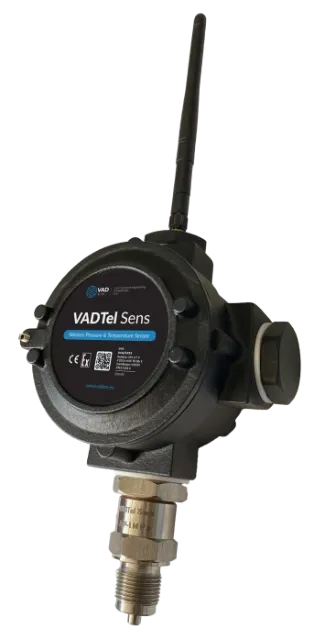
Operating logic
The sensor measures locally at a configurable interval. If the measured values remain within configured thresholds, the device returns to a low-power state and reports according to the heartbeat schedule. If a pressure or temperature threshold is exceeded, event-driven transmission starts and the dispatcher receives an alarm notification.
Process media and installation summary
VADTel-SENS is intended for media compatible with stainless steel AISI 316L / AISI 304, including gases, steam, water and mildly aggressive liquids. The device is mounted similarly to a pressure gauge; pressure should preferably be introduced from below, with measures taken against vibration, severe pulsation, condensation and freezing where relevant.
Documented pilot-operation evidence
Published pilot reports describe approximately 4,000 server sessions in 7 months on one low-pressure unit and approximately 10,000 sessions in 17 months on another, without battery replacement during the test period.
Technical specifications
Measurement
| Parameter | Value |
|---|---|
| Pressure type | Gauge or absolute |
| Pressure accuracy | ±1.0 / ±1.5 / ±2.0 / ±2.5 %FS |
| Permissible overload | 1.5 × full scale |
| Process temperature range | −40 to +85 °C |
| Temperature accuracy | ±1.0 °C standard; ±0.1 °C option |
Telemetry & control
| Parameter | Value |
|---|---|
| Cellular communications | GSM/GPRS or NB-IoT |
| Measurement interval | 5–600 s |
| Heartbeat / health report | 30 min to 24 h |
| Alarm-zone reporting interval | 5–60 min |
| Alarm thresholds | Server-configurable min./max. pressure and temperature limits |
| System integration | Secure Linux backend; IIoT / OPC UA / SCADA |
Power
| Parameter | Value |
|---|---|
| Power supply | Built-in rechargeable LiPo battery, nominal 3.7 V |
| Battery capacity options | 2,000 / 4,000 / 6,000 mAh |
| Guaranteed telemetry sessions | 5,000 / 7,500 / 10,000 server sessions |
| Autonomous operation | Up to 5 years typical; application-dependent |
| Battery service | Recharge / replacement by authorized service personnel only |
Environmental & mechanical
| Parameter | Value |
|---|---|
| Ambient operating temperature | −40 to +60 °C |
| Storage / transport | −50 to +60 °C; up to 95% RH at +35 °C |
| Ingress protection | IP65 (IEC 60529) |
| Process connection | M20 × 1.5 |
| Wetted media compatibility | Stainless-steel-compatible media (AISI 316L / AISI 304) |
| Housing / installation form | Field-mount sensor; installed similarly to a pressure gauge |
| Dimensions | Approx. 125 × 210 × 90 mm |
| Weight | Approx. 1.0–1.2 kg, depending on housing/options |
| Recommended recalibration interval | 36 months |
Available pressure ranges
- Gauge: low-pressure gas-network variant and 0–40 kPa version.
- Absolute: 0–160 kPa, 0–400 kPa, 0–600 kPa, 0–1.0 MPa, 0–1.6 MPa, 0–2.5 MPa, 0–4.0 MPa.
- Custom ranges up to 60 MPa on request.
Low-range source materials reference both 5 kPa and 7 kPa variants. Confirm the exact low-pressure range in the RFQ or order sheet.
Configuration options
- Accuracy class: ±1.0 / ±1.5 / ±2.0 / ±2.5 %FS.
- Battery: 2,000 / 4,000 / 6,000 mAh.
- Remote temperature probe option.
- Process cooler with remote temperature probe option.
- Hazardous-area housing version.
Standard delivery / accessories
- Sensor unit.
- External GSM / NB-IoT antenna.
- Product passport / datasheet.
- Operating manual and calibration method on request.
Engineering notes
- The datasheet uses EU / IEC terminology such as
%FSand IEC 60529 ingress ratings. - Ambient operating temperature and measured/process temperature are stated separately.
- Conservative ratings were selected where legacy source documents differed.
- Final product definition remains configuration-specific.
Remote setpoint configuration interface
Dispatcher-side configuration allows remote adjustment of the measurement interval, reporting schedule and min./max. alarm thresholds for each channel. During normal operation the sensor reports according to schedule; when configured pressure or temperature limits are exceeded, the device switches to event-driven reporting until the alarm condition clears.
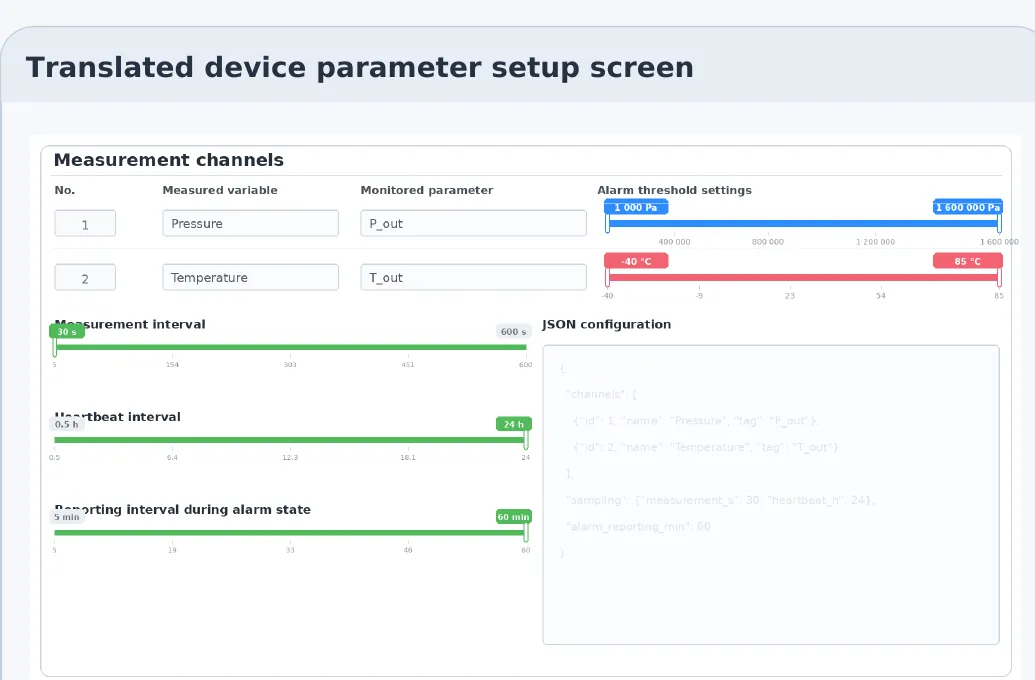
What the translated screen shows
- Pressure
P_outand temperatureT_out. - Alarm threshold bars for both channels.
- Measurement, heartbeat and alarm-state intervals.
- JSON view of the active configuration.
EU compliance and installation notes
Regulatory adaptation for the EU market
- A manufacturer RoHS declaration is published for V.A.D. products in accordance with Directive 2011/65/EU and Delegated Directive (EU) 2015/863.
- For a marketed cellular version, the applicable EU legislation typically includes RED 2014/53/EU, RoHS 2011/65/EU and WEEE 2012/19/EU.
- The hazardous-area version described in EU: CE 1354 II 2G Ex d IIC T6 Gb X
- Use in hazardous areas within the EU requires a version carrying valid ATEX / IECEx marking together with the corresponding declaration and certificate set.
- CE marking is product-specific and may only be applied after final conformity assessment of the placed-on-market EU variant.
No unverified CE or ATEX claim is made on this page.
Installation and service precautions
- Mount similarly to a pressure gauge and apply mechanical load only to the process connection, not to the housing.
- Avoid severe vibration, shocks and pressure pulsation above approximately 10% of nominal range.
- If process temperature exceeds the permitted device limit, use an impulse line or cooler.
- Protect the housing against condensation and freezing in low-temperature service.
- Do not open the unit in a hazardous area; battery service must be carried out by authorized personnel only.
Configurable telemetry workflow
- Measure — Pressure and temperature are measured locally every 5–600 seconds.
- Compare — Measured values are checked against configured minimum and maximum thresholds.
- Sleep / heartbeat — If values are normal, the unit returns to low power and reports every 30 min to 24 h.
- Alarm report — If thresholds are exceeded, event-driven transmission starts every 5–60 min until the condition clears.
Published field evidence
- An interregional-gas pilot protocol documents approximately 4,000 server sessions in 7 months on one test unit and approximately 10,000 sessions in 17 months on another test unit.
- The same pilot notes average monthly traffic of approximately 60 kB and regular reporting by schedule and on threshold events.
- A pilot letter reports 93-94% remaining battery charge after 267 communication sessions in a pilot installation and observed pressure-measurement accuracy not worse than ±20 Pa on a 0–40 kPa unit.
Tender / order-sheet checklist
- Pressure type: gauge or absolute.
- Required pressure range and accuracy class.
- Battery capacity and expected reporting profile.
- Communication technology and antenna arrangement.
- Need for remote temperature probe or cooler.
- Whether a hazardous-area certified variant is required for the final EU installation.
Was this page helpful?
Thanks for your feedback!