Operational Issues y ciclo de vida
El Operational Issue como unidad de trabajo — modelo base, diferencia entre Issue y Task, tipos único y masivo, el workflow de estados con su matriz de transiciones y el registro de auditoría inmutable.
Operational Issue
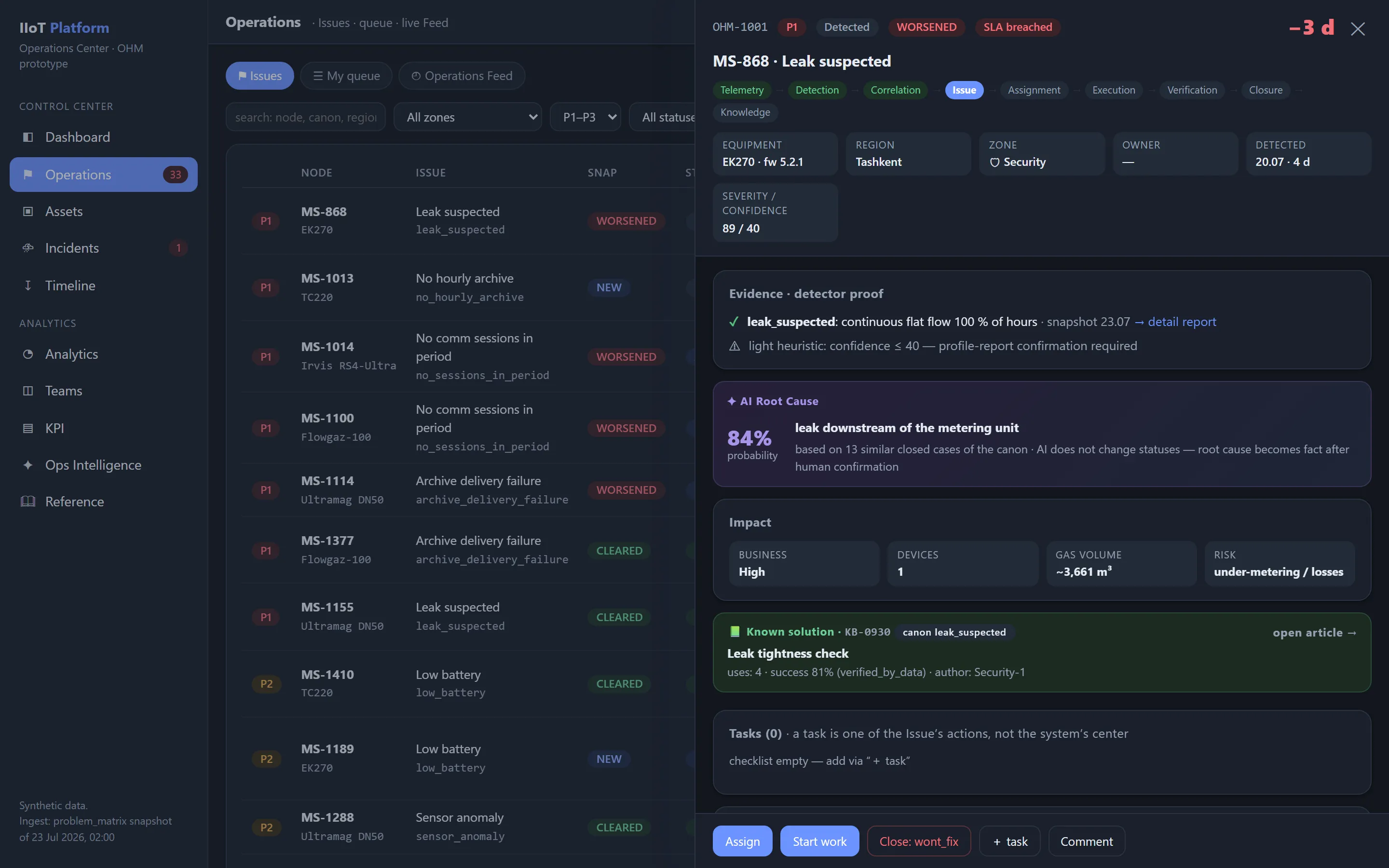
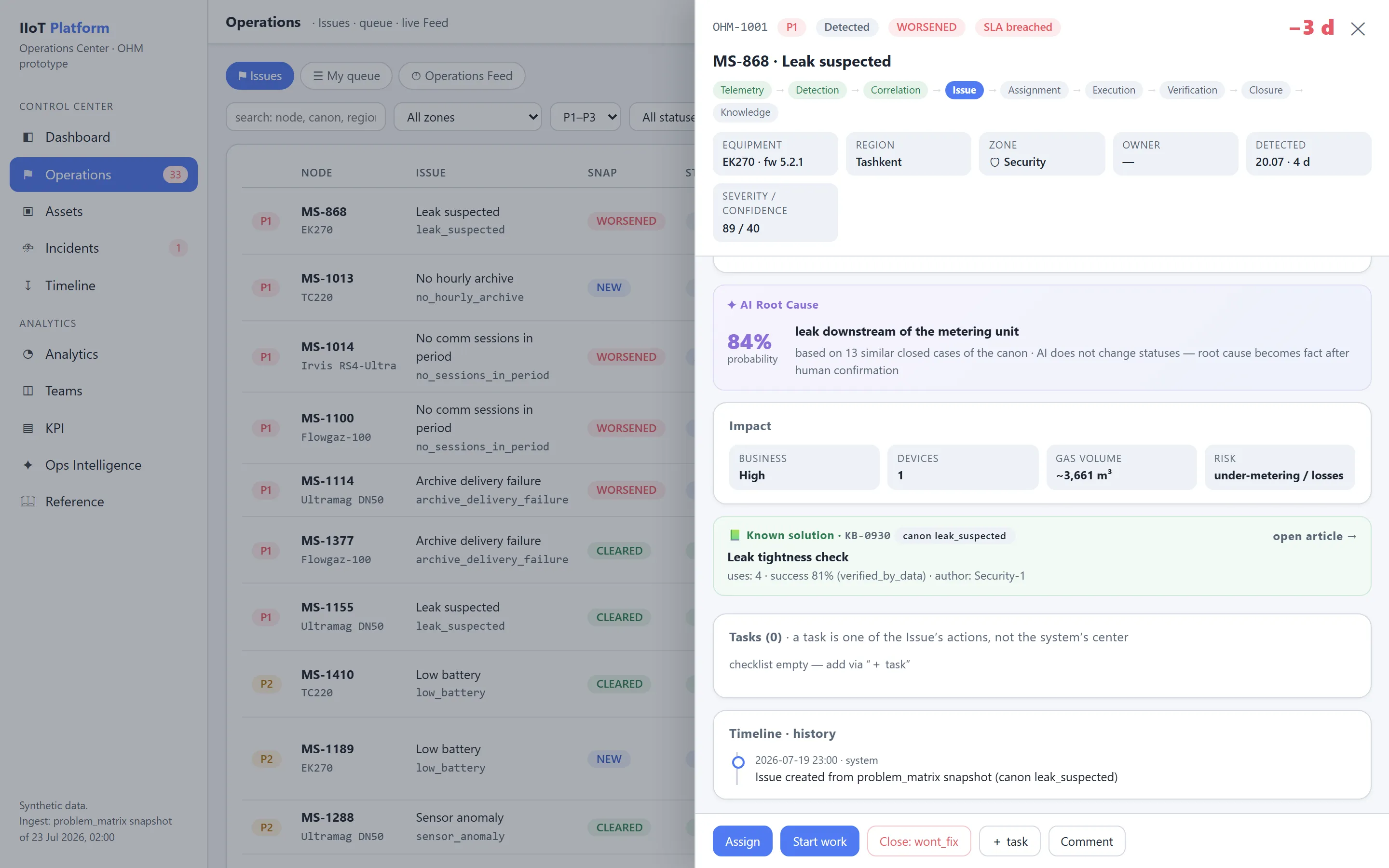
Operational Issue es la entidad central de OHM.
Es un objeto con estado (stateful) que representa un problema de explotación durante todo su ciclo de vida.
Modelo base
id: OHM-2026-001842
kind: single
canon: no_hourly_archive
title: 'Hourly archive is missing'
priority: P1
severity: critical
confidence: 0.94

scope:
  organization: 'Demo Gas Utility'
  region: 'North'
  asset_id: 'station-5690'

ownership:
  zone: backend_integration
  assignee: 'Integration-2'

timestamps:
  first_detected_at: '2026-07-21T04:00:00Z'
  created_at: '2026-07-21T04:03:12Z'
  acknowledged_at: '2026-07-21T05:10:00Z'
  due_at: '2026-07-22T04:00:00Z'
  resolved_at: null

status:
  workflow: in_progress
  snapshot: persistent
  overdue: false
  unattended: false
  chronic: false

root_cause:
  class: communication
  hypothesis: 'device does not establish a communication session'
  confidence: 0.82
  confirmed: false

evidence: []
tasks: []
history: []
related_issues: []
knowledge_articles: []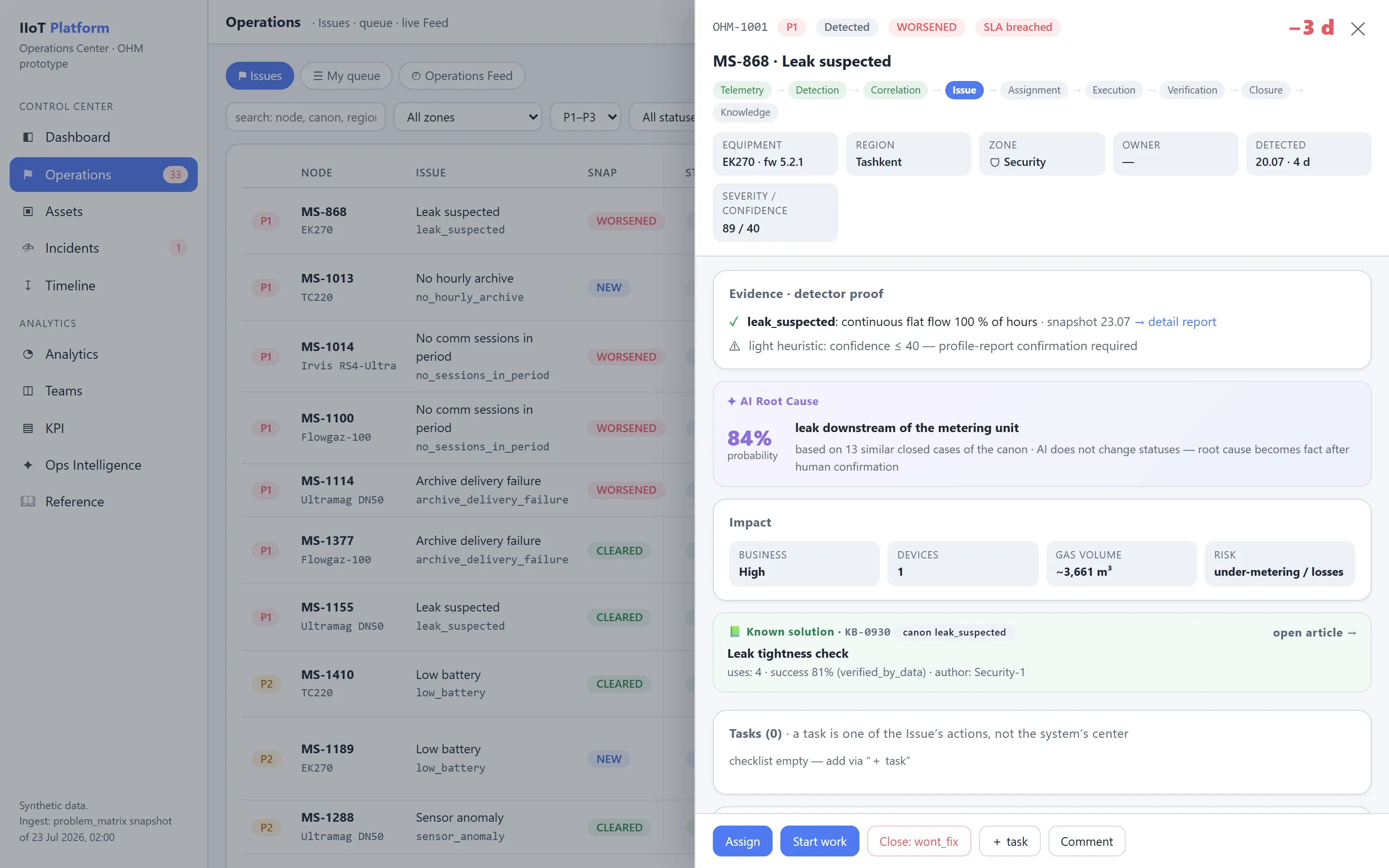
Issue y Task son entidades distintas
Un Issue responde a la pregunta:
¿Qué problema de explotación hay que resolver?
Un Task responde a la pregunta:
¿Qué acción concreta hay que ejecutar?
Un mismo Issue puede contener varias tareas. Para el Issue falta el archivo en 38 dispositivos:
- Task 1 — comprobar la disponibilidad del gateway;
- Task 2 — revisar la cola del servidor;
- Task 3 — comparar las versiones de firmware;
- Task 4 — ponerse en contacto con el operador de red móvil;
- Task 5 — realizar una inspección de campo por muestreo.
El cierre de una sola tarea no cierra automáticamente el Issue.
Issues únicos y masivos
OHM emplea un único modelo para ambas escalas:
| Tipo | Descripción |
|---|---|
single | problema que afecta a un activo o a una entidad lógica |
massive | incidente sistémico que afecta a un grupo de activos |
manual | problema registrado por una persona |
external | problema importado de un sistema externo |
Ciclo de vida de un Operational Issue
Workflow principal
flowchart TD
  S1["Detectado"] --> S2["Triaje realizado"]
  S2 --> S3["Asignado"]
  S3 --> S4["Aceptado"]
  S4 --> S5["En curso"]
  S5 --> S6["Pendiente de verificación"]
  S6 --> S7["Verificado"]
  S7 --> S8["Resuelto"]
  S8 --> S9["Archivado"]
Desenlaces finales adicionales:
- cancelado;
- duplicado;
- no reproducido;
- no se corregirá;
- riesgo aceptado.
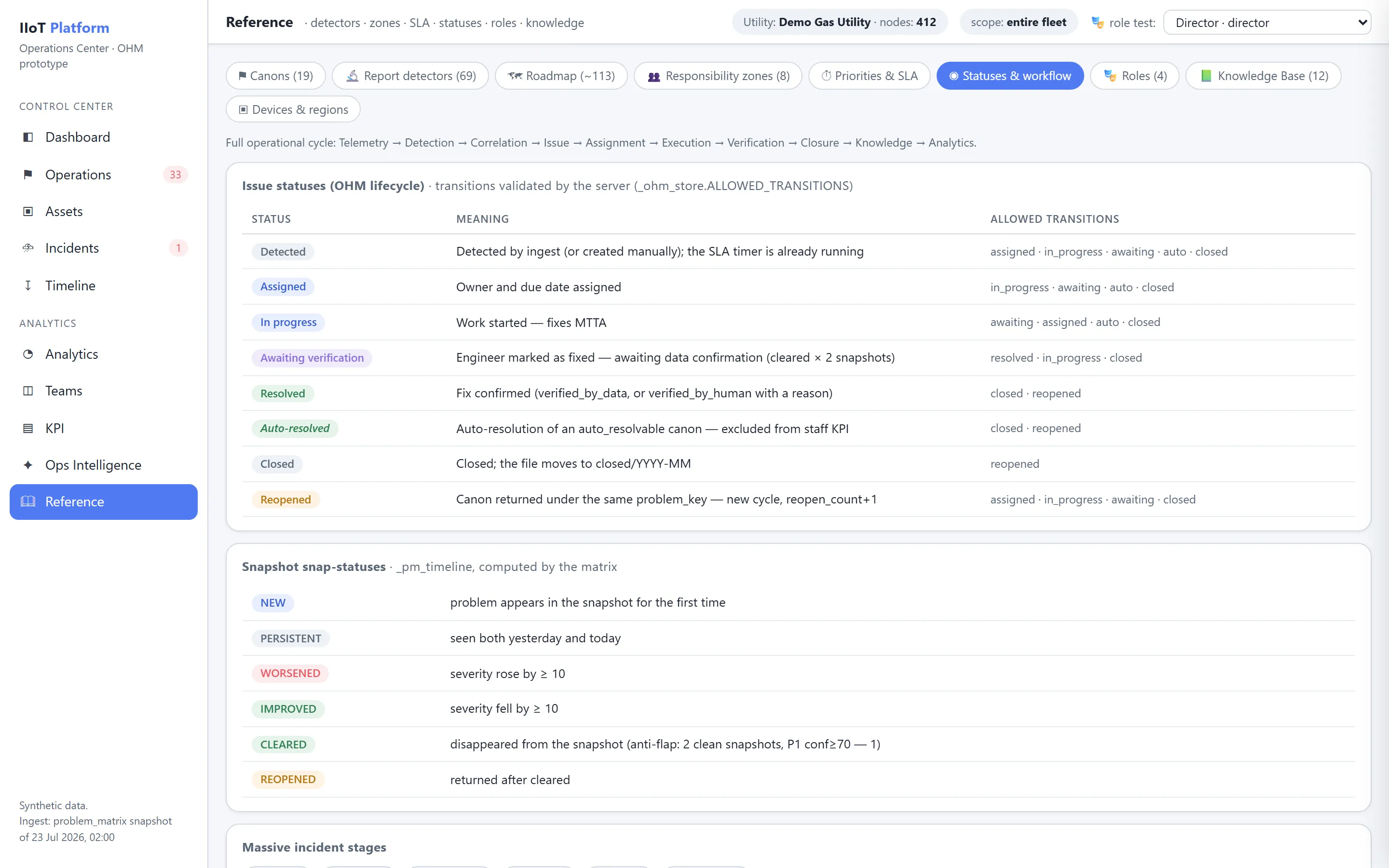
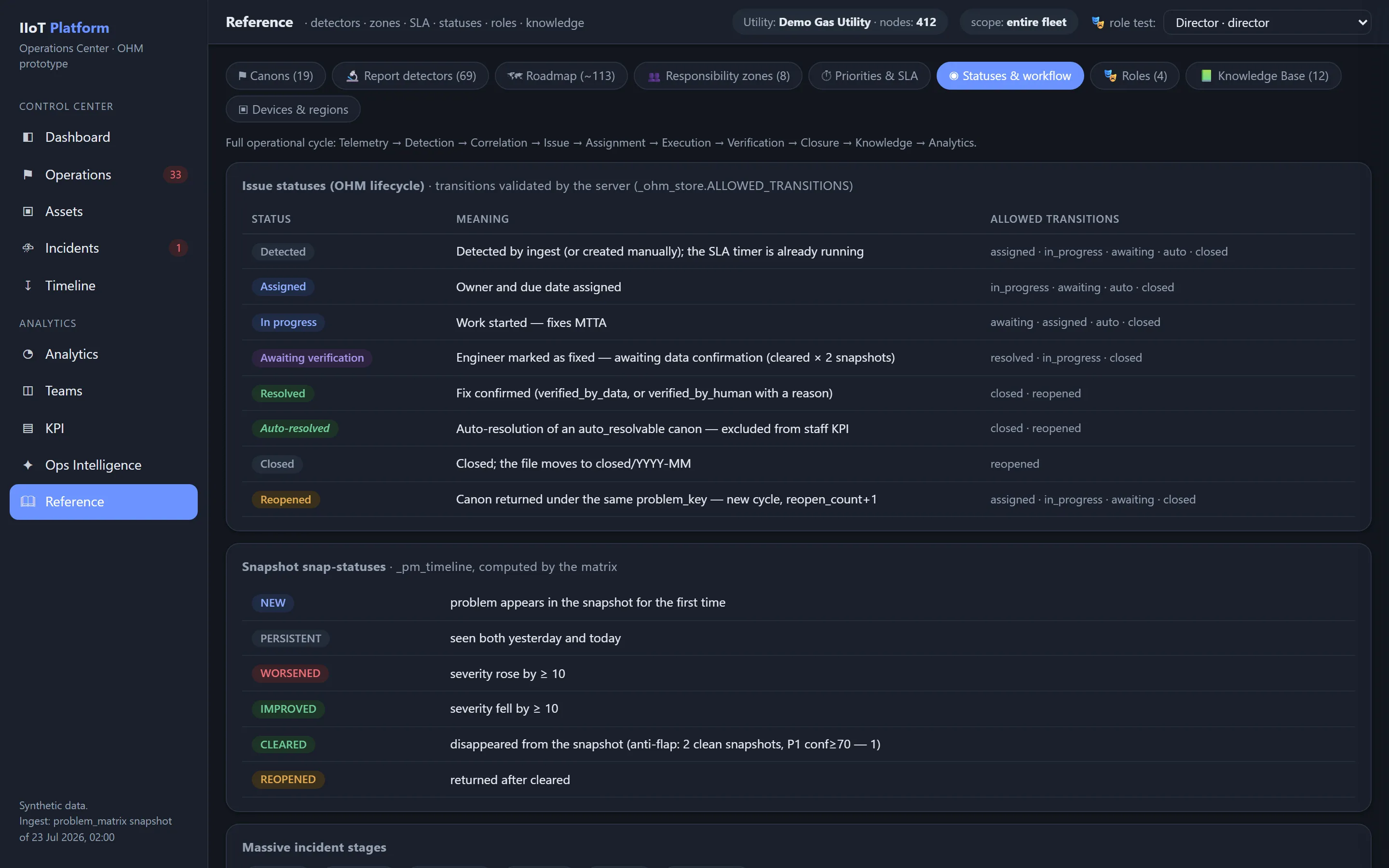
Estados del workflow
| Estado | Significado |
|---|---|
detected | el Issue se creó de forma automática o manual |
triaged | se han revisado la criticidad (Severity), la zona de responsabilidad y el contexto inicial |
assigned | se ha determinado el ejecutor responsable |
accepted | el ejecutor ha confirmado la aceptación |
in_progress | los trabajos están en curso |
awaiting_verification | el trabajo se declara terminado y queda a la espera de verificación |
verified | el resultado se ha confirmado |
resolved | el Issue se cierra con un resultado establecido |
archived | el objeto finalizado se ha trasladado al historial de largo plazo |
cancelled | el Issue se canceló por un motivo documentado |
duplicate | el Issue es un duplicado de otro objeto |
not_reproduced | el problema no se confirmó durante la verificación |
wont_fix | se tomó la decisión de gestión de no repararlo |
accepted_risk | el riesgo fue aceptado formalmente por una persona autorizada |
Estado del Snapshot
Además del workflow, OHM mantiene el estado del problema según el Snapshot diario de los detectores:
| Estado del Snapshot | Significado |
|---|---|
new | el problema aparece por primera vez |
persistent | el problema persiste |
worsened | el estado ha empeorado |
improved | el estado ha mejorado, pero el problema no ha desaparecido |
cleared | el detector ya no confirma el problema |
reopened | el problema ha vuelto a aparecer tras el cierre |
El estado del workflow y el estado del Snapshot nunca se mezclan.
Ejemplo: workflow_status = in_progress junto con snapshot_status = improved.
Esto significa que los trabajos siguen en curso mientras los datos objetivos ya muestran una mejora.
Matriz de transiciones
| Estado actual | Transiciones permitidas |
|---|---|
| detected | triaged, assigned, duplicate, cancelled |
| triaged | assigned, cancelled, accepted_risk |
| assigned | accepted, in_progress, reassigned |
| accepted | in_progress, reassigned |
| in_progress | awaiting_verification, escalated, accepted_risk |
| awaiting_verification | verified, in_progress |
| verified | resolved |
| resolved | reopened, archived |
| reopened | triaged, assigned, in_progress |
| cualquiera activo | duplicate, cancelled |
Cada transición queda registrada en un log de eventos inmutable.
Registro de auditoría (Audit Trail)
Todas las acciones significativas se registran en un historial inmutable.
Un evento contiene:
event_id: EVT-9038172
issue_id: OHM-2026-001842
event_type: status_changed
timestamp: '2026-07-23T10:14:00Z'
actor:
  type: user
  id: 'usr-231'
  role: 'zone_manager'
before:
  status: assigned
after:
  status: in_progress
reason: 'Diagnostics started'
source:
  ip: 'masked'
  client: 'web'
correlation_id: 'req-982310'Se registran siempre:
- la creación;
- la asignación;
- la reasignación;
- el cambio de prioridad;
- el cambio de plazo;
- el cambio de estado;
- el comentario;
- la incorporación de Evidence;
- la confirmación de la Root Cause;
- la verificación manual;
- la aceptación del riesgo;
- la aplicación de un artículo de la KB;
- la fusión y la división de Issues;
- el cambio de configuración de un detector;
- las acciones de exportación e integración.
Temas relacionados
¿Te resultó útil esta página?
¡Gracias por tus comentarios!