Détecteurs et problèmes canoniques
Comment les détecteurs transforment la télémétrie en constats et les canons, ces constats en problèmes gérés : classes de détecteurs, verrous de qualité des données, catalogue des canons et analytique de la qualité des détecteurs.
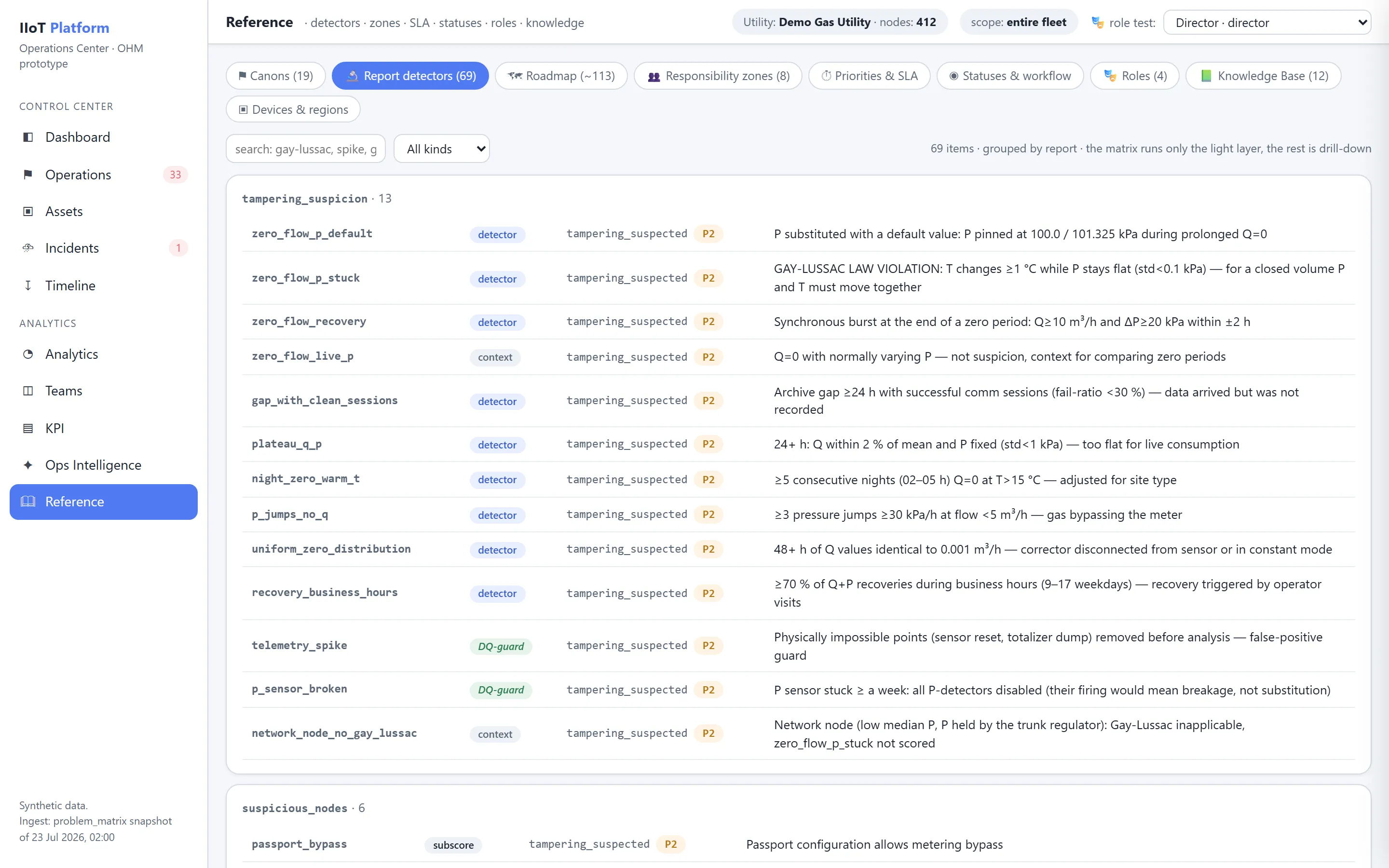
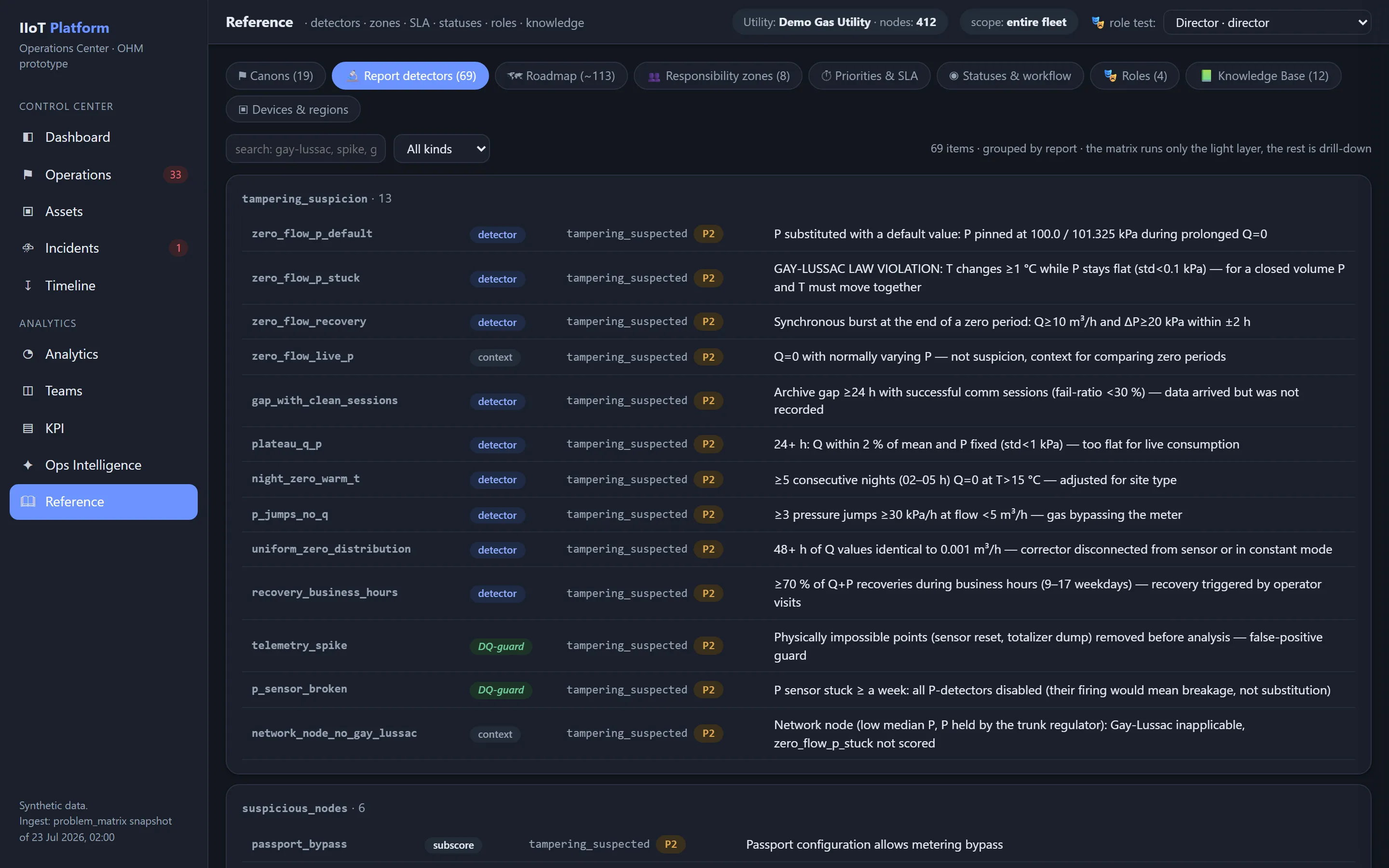
Architecture des détecteurs
Détecteur (Detector)
Un Detector est un algorithme qui analyse un jeu de données défini et produit un constat formalisé (finding).
Un détecteur ne pilote pas l’exécution et ne rédige pas de texte libre. Son résultat a un format structuré.
detector_id: archive.tail_gap.v3
detector_version: '3.2.1'
run_id: 'run-20260723-0400'
asset_id: 'station-5690'
observed_at: '2026-07-23T04:00:00Z'

finding:
  canon: no_hourly_archive
  detected: true
  severity: critical
  confidence: 0.98
  value: 73
  unit: 'hours'
  threshold: 24
  baseline: 0

evidence:
  last_valid_hour: '2026-07-20T03:00:00Z'
  expected_end: '2026-07-23T04:00:00Z'
missing_hours: 73Chaîne Detector → Canon → Issue
flowchart TD
  D["Detector"] -->|"classification"| C["Canon"]
C -->|"gestion"| I["Operational Issue"]Detector— un algorithme particulier ;Canon— un type stable de problème d’exploitation ;Operational Issue— une instance du problème dans un contexte donné.
Plusieurs détecteurs différents peuvent confirmer un même canon.
Exemple :
flowchart TD
  D1["archive.tail_gap.v3"] --> CANON["no_hourly_archive"]
  D2["archive.coverage.v2"] --> CANON
  D3["archive.delivery_queue.v1"] --> CANON
  D4["session.freshness.v4"] --> CANON
  CANON --> ISSUE["OHM-2026-001842"]
Classes de détecteurs
| Classe | Finalité |
|---|---|
| Connectivity | communication, sessions, disponibilité, signal |
| Archive | complétude et livraison des archives |
| Data Quality | validité, lacunes, contradictions |
| Metering | débit, volume, relations métrologiques |
| Pressure | plages, pics, valeurs figées |
| Temperature | plages, tendances, cohérence physique |
| Power | batterie, alimentation, dégradation |
| Registry | registre, doublons, objets fantômes |
| Passport | complétude et exactitude du passeport |
| Integrity | signes d’altération et atteintes à l’intégrité |
| Security | événements d’accès et de configuration anormaux |
| Firmware | erreurs, incompatibilités, régressions |
| Topology | dépendances entre équipements, passerelles et services |
| Operations | retards, absence de propriétaire, récurrence |
| Predictive | prévision de panne ou de dégradation |
Exigences applicables à chaque détecteur
Tout détecteur en production possède :
- un
detector_idunique ; - une version sémantique ;
- une finalité déclarée ;
- un propriétaire ;
- une description des données d’entrée ;
- des seuils contrôlés ;
- des règles d’exclusion ;
- des exigences de taille minimale d’échantillon ;
- des verrous DQ ;
- une formule de Severity ;
- une formule de niveau de confiance ;
- un canon correspondant ;
- un jeu d’Evidence ;
- des tests ;
- un échantillon de contrôle ;
- une estimation des faux positifs ;
- une date de mise en service ;
- un journal des modifications ;
- un mode de désactivation et un retour arrière (rollback).
Verrous de qualité des données (Data Quality Gates)
Un détecteur ne doit pas produire un niveau de confiance élevé si les données sources sont incomplètes ou contradictoires.
Exemples de verrous :
| Condition | Effet sur le détecteur |
|---|---|
Pas d’asset_id valide | bloquer l’action automatique |
| Historique insuffisant | abaisser le niveau de confiance |
| Horodatage erroné | ne pas calculer la fraîcheur |
| Pas d’unité de mesure | ne pas comparer à un seuil physique |
| Échantillon trop petit | ne pas établir de prévision |
| Objet fantôme du registre | rendre les Issues associées non-actionable |
Santé des détecteurs (Detector Health)
OHM surveille la qualité des détecteurs eux-mêmes.
Principaux indicateurs :
- nombre de déclenchements ;
- part des déclenchements confirmés ;
- taux de faux positifs ;
- part des annulations manuelles ;
- part des réouvertures ;
- distribution du niveau de confiance ;
- dérive des données d’entrée ;
- évolution de la structure de l’échantillon ;
- temps moyen jusqu’à la confirmation ;
- version de l’algorithme ;
- nombre d’Issues actives par version.
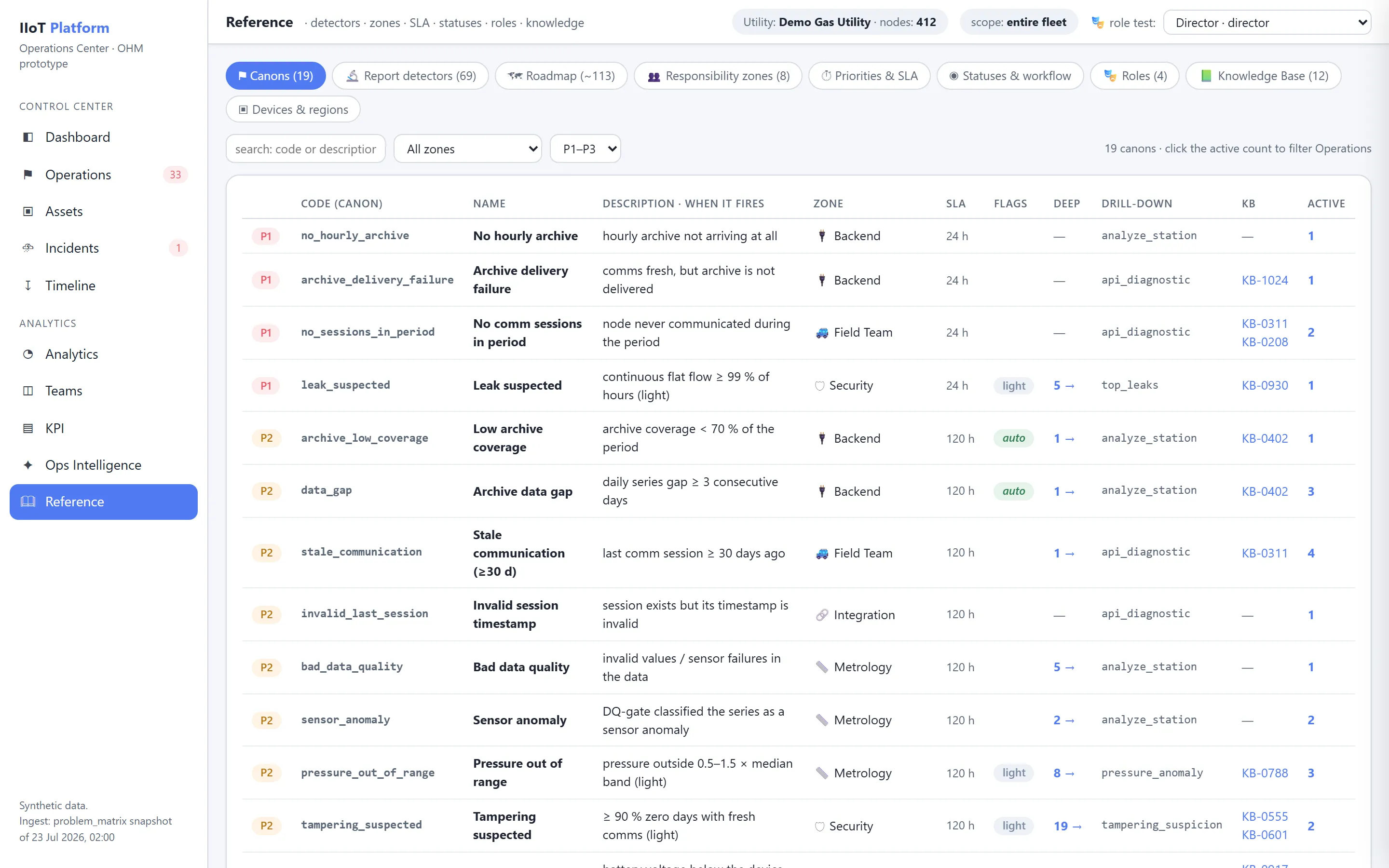
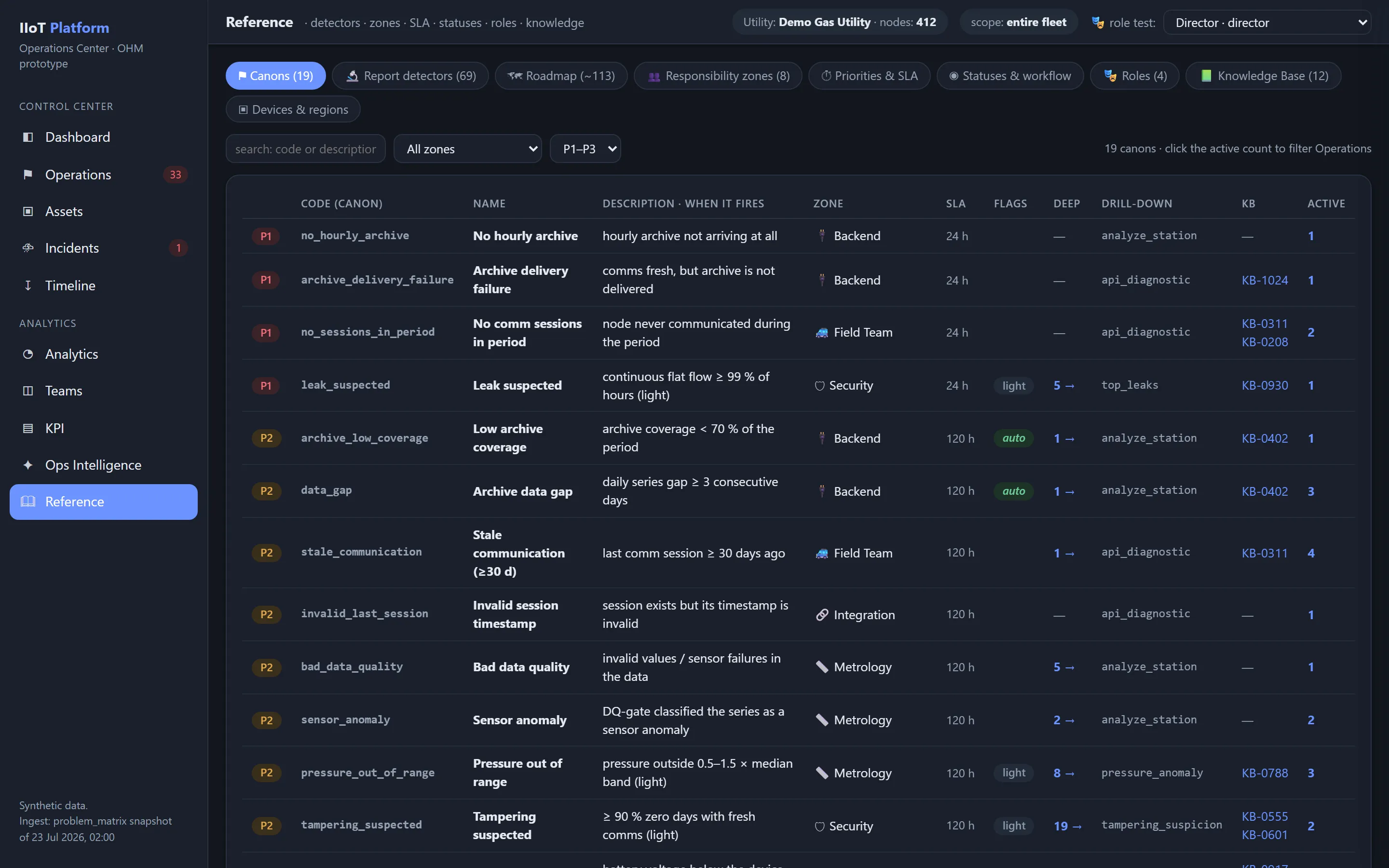
Problèmes canoniques
Un Canon est une classification métier stable d’un problème, indépendante de l’implémentation d’un détecteur particulier.
Pourquoi les canons sont nécessaires
Sans canons, un système analytique dégénère rapidement en un ensemble de messages incohérents :
archive_missingno_archivearchive_gaphourly_data_absentdelivery_error
Le canon réunit tous ces signaux équivalents sous un identifiant unique : canon: no_hourly_archive.
Cela apporte :
- un workflow unique ;
- un SLA unique ;
- une analytique claire ;
- des KPI stables ;
- une base de connaissances commune ;
- la comparabilité entre versions ;
- la traduction de l’interface sans modification de la logique ;
- l’intégration avec les systèmes externes.
Structure d’un canon
canon_id: no_hourly_archive
name: 'Hourly archive is missing'
domain: archive
default_owner_zone: backend_integration
default_priority: P1
actionable: true
verification_mode: data
sla_policy: archive_p1
suppression_group: communication_archive
knowledge_tags:
  - archive
  - delivery
  - communication
Jeu de canons de base
| Canon | Signification | Zone principale |
|---|---|---|
no_sessions_in_period | aucune session sur la période analysée | intégration / communication |
stale_communication | l’équipement n’a pas communiqué depuis longtemps | terrain / communication |
no_hourly_archive | l’archive horaire est absente | backend / intégration |
archive_delivery_failure | l’archive a été générée mais non livrée | backend / intégration |
archive_incomplete | l’archive est incomplète | service de comptage |
abnormal_session_length | durée de session anormale | communication / intégration |
battery_low | réserve de batterie critiquement basse | service |
battery_unknown | état de la batterie inconnu | service / intégration |
passport_incomplete | données du passeport incomplètes | métrologie |
registry_ghost | l’objet existe logiquement mais n’est pas confirmé physiquement | registre |
registry_duplicate | conflit ou doublon d’identifiants | registre |
pressure_out_of_range | pression hors de la plage admissible | exploitation |
pressure_sensor_stuck | le capteur de pression ne varie pas alors qu’une dynamique est attendue | métrologie / service |
temperature_out_of_range | température hors de la plage admissible | exploitation |
data_quality_degraded | la qualité des données ne permet pas une analyse fiable | intégration |
firmware_regression | les problèmes sont liés à une version de firmware | firmware / backend |
tampering_suspected | signes d’une possible altération détectés | sécurité / métrologie |
leak_suspected | signes indirects d’une fuite possible détectés | exploitation |
topology_dependency_failure | les symptômes sont causés par la défaillance d’un composant commun dont ils dépendent | backend / infrastructure |
Versionnement des canons
La modification d’un texte ou d’une traduction n’impose pas de changer l’identifiant.
Une nouvelle version du canon est requise dès que l’un des éléments suivants change :
- la signification métier ;
- la règle d’affectation ;
- le critère d’actionability ;
- la méthode de vérification ;
- le principe de SLA ;
- la logique de fusion avec d’autres problèmes.
Analytique de la qualité des détecteurs
L’Operational Health Matrix évalue non seulement les équipements, mais aussi la qualité de ses propres algorithmes analytiques.
Pour chaque Detector, le système calcule :
- Accuracy ;
- Precision ;
- Recall ;
- False Positive Rate ;
- False Negative Rate ;
- la confiance moyenne ;
- Drift ;
- Stability ;
- le temps moyen de vérification ;
- le taux d’acceptation.
Cette approche permet d’améliorer en continu le modèle analytique de la Data Platform sans compromettre la reproductibilité des résultats.
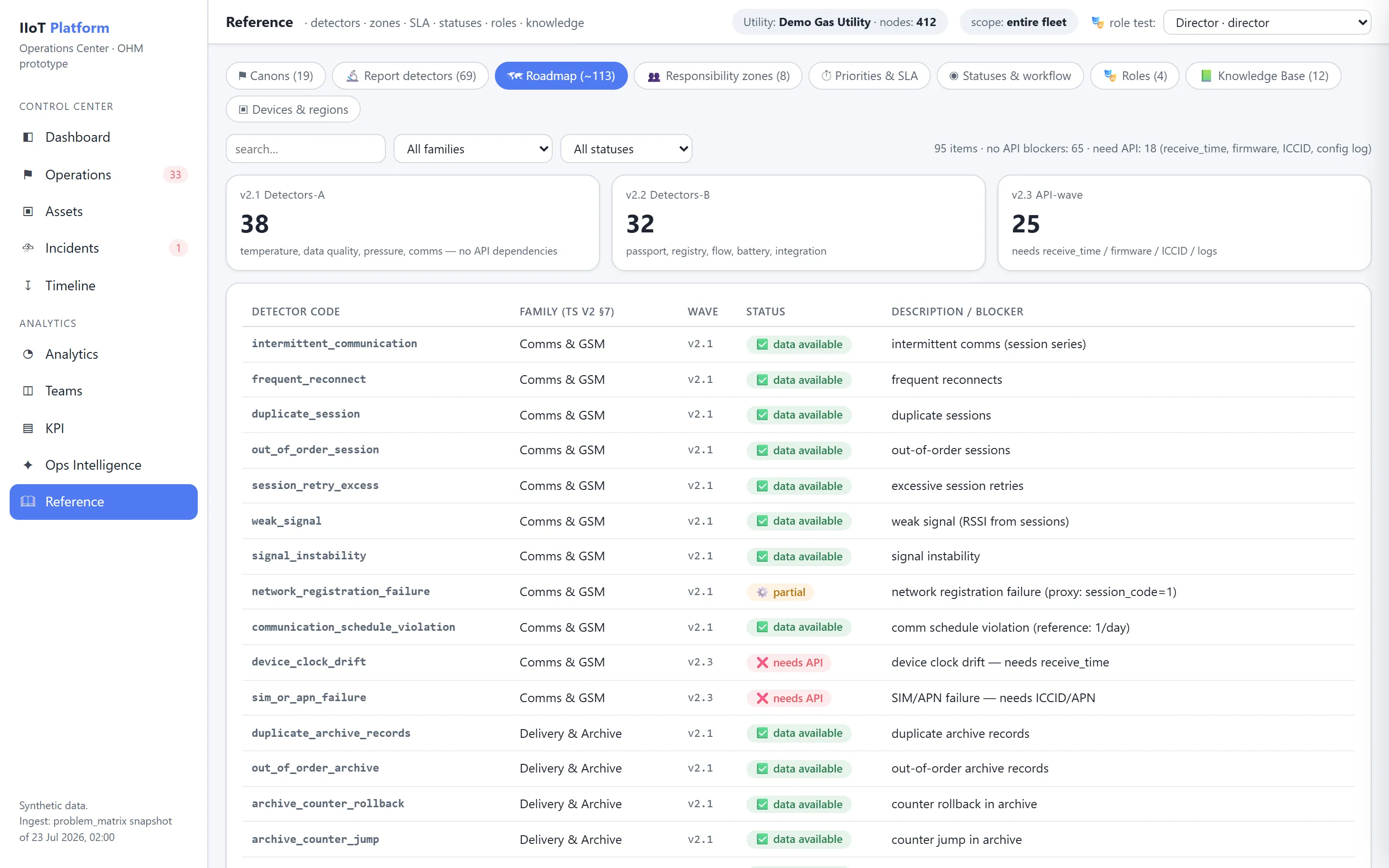
Le portefeuille de détecteurs évolue lui-même selon une roadmap par étapes : les nouveaux détecteurs sont introduits par vagues, chaque vague étant conditionnée par la disponibilité des API sous-jacentes de la plateforme.
Sujets connexes
Cette page vous a-t-elle été utile ?
Merci pour votre retour !