Platform architecture
A unified top-level DBMS structure that abstracts away device, platform, and protocol specifics to provide a single data representation for all equipment.
The architecture of the Data Platform is built around a top-level database management system (DBMS) that provides a unified data representation for all types of equipment. It rests on universal principles that abstract away the specifics of individual devices, platforms, and protocols.
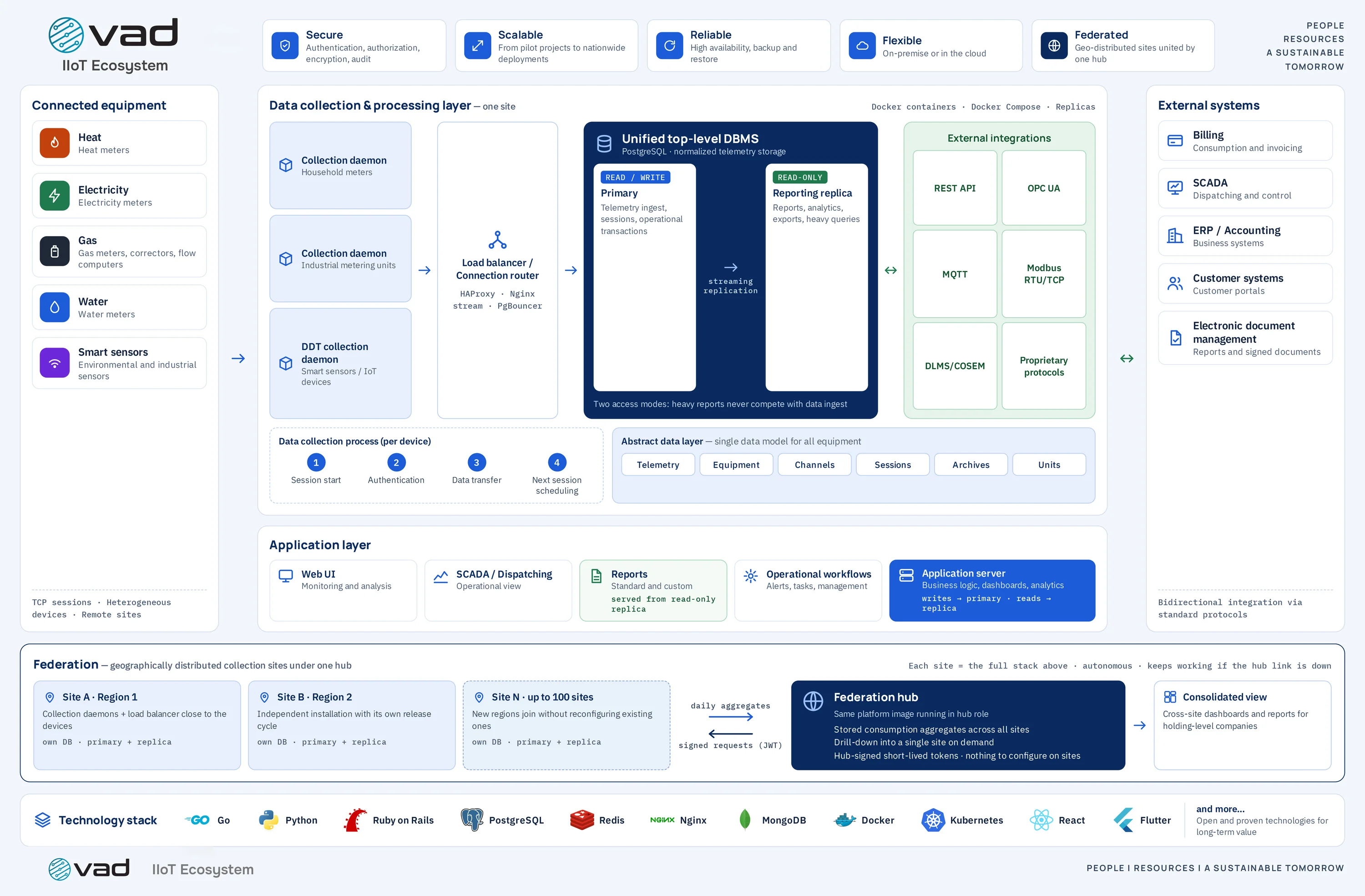
Architecture layers
Two layers form the core of the data architecture: the layer that ingests telemetry from equipment, and the abstract layer that normalizes it into a single representation.
Cross-cutting capabilities
Several capabilities span the entire platform rather than belonging to a single layer:
- A unified access interface exposes the normalized data through a single API.
- Data security mechanisms protect telemetry in transit and at rest.
- Scalability lets the system grow from a handful of devices to large distributed deployments.
- Integration with diverse equipment brings devices of different types into a common model.
- Backup and restore safeguards stored data against loss.
What the architecture provides
The top-level DBMS of the platform provides:
- A unified data representation for all types of equipment.
- Universal protection, access, and scaling mechanisms.
- Flexibility and adaptability to new technologies and requirements.
This framework can be used in any environment, from small IoT devices to large distributed systems.
Related topics
Was this page helpful?
Thanks for your feedback!